

Share


Two-day tactical exercise bridges classroom learning and real-world leadership.
Submission by Lily Fabela, University of the Cumberlands’ sophomore from Williamstown, Kentucky.
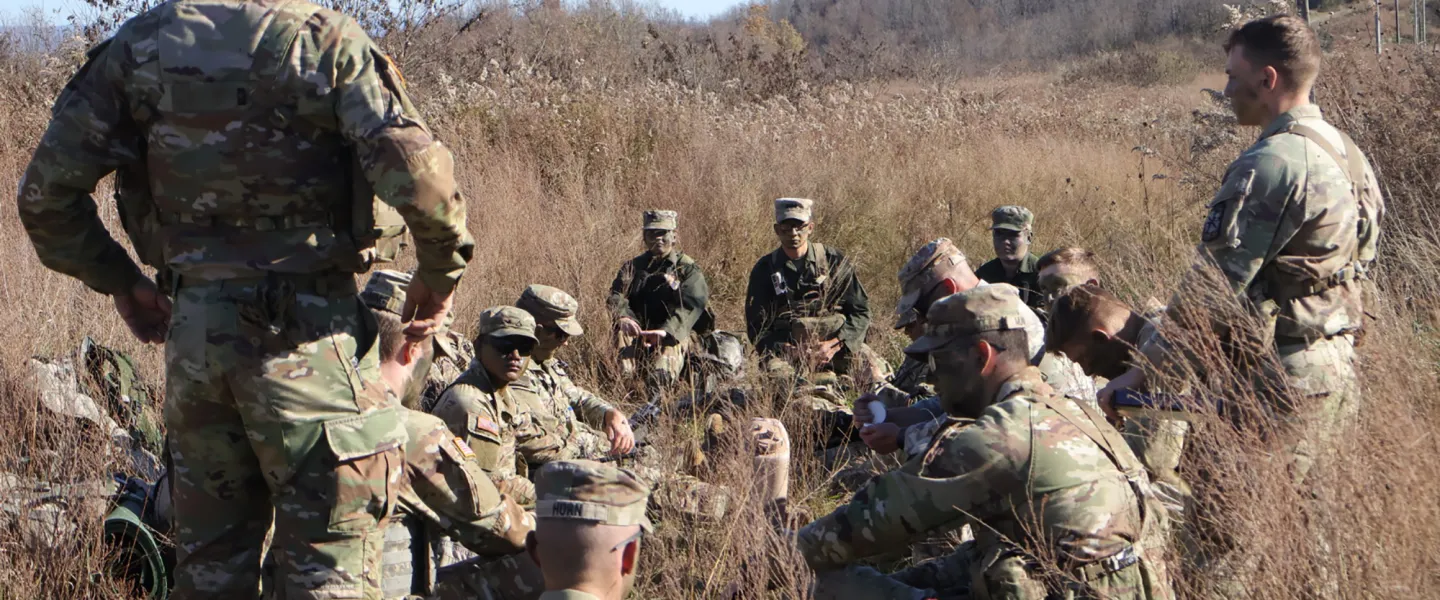
Cadets in University of the Cumberlands’ Army ROTC program strengthened their leadership, resilience, and tactical abilities during the annual Fall Field Training Exercise (FTX), held Nov. 14–15 at the university’s Wildlife Management Area.
The two-day event emphasized teamwork, fieldcraft, and squad-level mission execution. It also reinforced Cumberlands’ mission to offer career-relevant, outcome-driven education that prepares students for leadership and service in the real world.
The weekend began early Friday morning with a six-mile ruck from the Nicholson-Jones Building to the training site. Unlike last year, when cadets had access to a fixed structure for rest and recovery, this year’s participants carried all the equipment they would need for the entire weekend and slept under the stars.
MS3 Mason Preston, a junior from Edgewood, Kentucky, explained the immediate impact of that challenge.
“Once you reach the top, you feel like you’ve already accomplished something—and that’s just the beginning,” Preston explained.
Lt. Col. Jim Plutt, professor of military science, said the increase in physical demands was intentional.
“The change better builds their soldier skills, which really stood out to me,” he said.
After reaching the training area, cadets collected Meals Ready to Eat (MREs), took roll, and shared lunch while resting on their rucks. Refueled and reenergized, they immediately moved into tactical lanes focused on ambush operations.
Squads were led by MS3 cadets, while others served as opposing forces to create realistic conditions. Cadets built terrain models, briefed operations orders, and executed their missions before transitioning into after-action reviews.
MS3 Jesse Jones, a junior from Jacksboro, Tennessee, served as a squad leader during the exercises.
“The mission went very well,” he reflected. “We completed it, but the operations order and planning process could have been better. It showed me what I need to refine.”
Jones said his squad’s teamwork impressed him the most.
“My Alpha and Bravo team leaders helped me a lot,” he added. “The cohesion between us was really strong. Everyone worked together to get the job done.”
MS2 Elijah Nickell, a sophomore from Nicholasville, Kentucky, rotated between team leader roles. He said executing battle drills in real conditions helped him build confidence.
“The most rewarding part was becoming more comfortable with what to do during the mission,” Nickell said.
For some cadets, this was their first full-scale training experience. MS1 Levi Gilpin, a freshman from London, Kentucky, served as opposing forces and said the weekend exceeded his expectations.
“It was probably the coolest thing I’ve ever done,” Gilpin said as a matter of fact.
Seeing upperclassmen lead missions shifted his perspective on ROTC.
“It makes you realize this is real,” he said. “We’re not just playing around—people do this.”
Throughout the weekend, cadets conducted after-action reviews to evaluate communication, decision-making, and movement techniques. These reflections helped squads identify both strengths and areas for improvement.
Capt. Corey Blankenship, assistant professor of military science, said the FTX delivered the kind of hands-on learning cadets need.
“Some cadets really excelled, and others identified areas they need to work on—which is exactly what an FTX is for,” he explained.
He emphasized that field exercises bridge the gap between classroom learning and real-world performance.
“Cadets learn to perform under pressure and build teamwork, which you only get in the field,” Blankenship said. “Our MS4s designed this FTX from the ground up. Soon they’ll be doing this as platoon leaders.”
The training also strengthened connections between Cumberlands’ and Eastern Kentucky University’s ROTC programs. EKU cadets joined the weekend’s events, working and learning alongside Cumberlands cadets.
Jones said that experience made a noticeable difference in his learning.
“You meet people you’ve never worked with before,” he said. “We could end up serving together someday.”
Plutt said that unity is a key goal for the battalion.
“We want them to operate as one team, not separate elements,” he said. “Cumberlands hosting the FTX was a big step in that direction.”
After completing Saturday’s final missions and reviews, cadets packed up their patrol base and conducted a short ruck—about one to two miles—back to the pavilion area. From there, they boarded buses and returned to their respective universities.
Plutt said the weekend showcased what successful training looks like.
“Everything demonstrated this weekend was textbook, focused, realistic, and effective,” he said.
With the fall semester complete, cadets now look ahead to spring’s more advanced collective training—bringing with them the lessons, confidence, and camaraderie built on Patriot Mountain.
About Army ROTC at University of the Cumberlands
The Army ROTC program at Cumberlands helps students develop the leadership, decision-making, and physical training needed for successful military or civilian careers. Cadets graduate with both a college degree and a strong foundation in service, discipline, and real-world preparedness.
To learn more, visit www.ucumberlands.edu/student-life/clubs-organizations/rotc.
Share