

Share


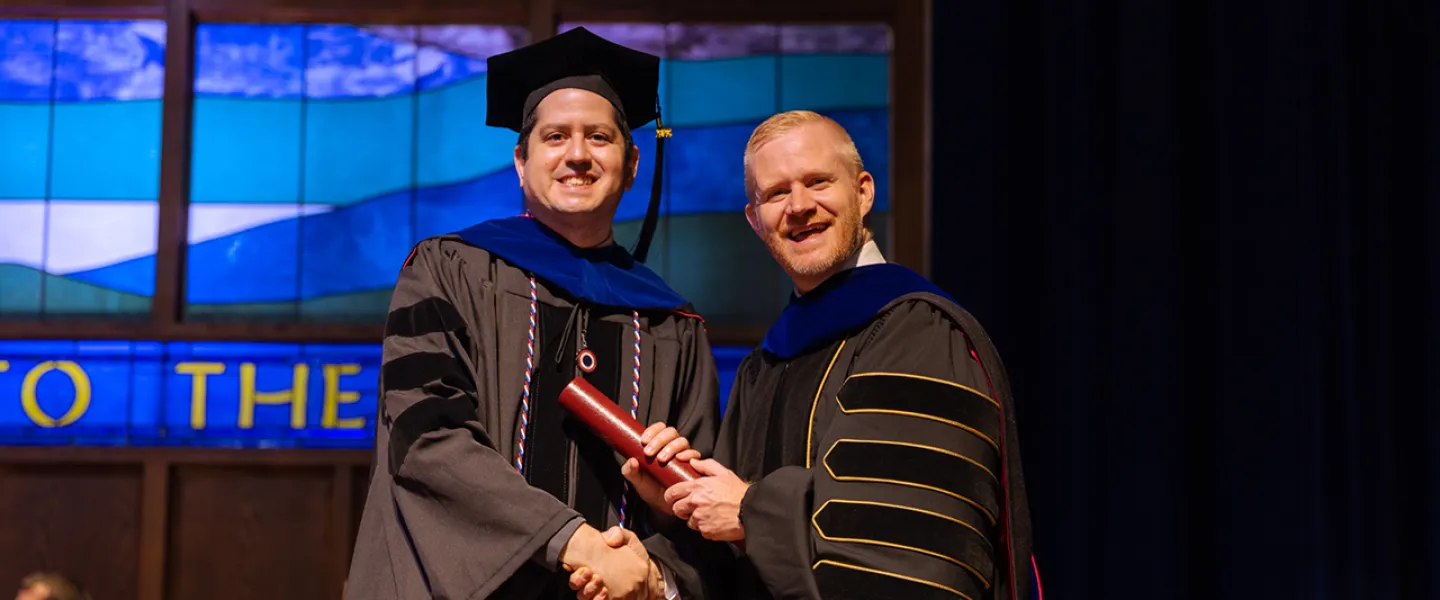
Through graduate education, published research, and mentorship, Army veteran Christopher Rodriguez is helping create new opportunities for fellow veterans.
For many veterans, transitioning to civilian life means asking a new question: What's my next mission?
For Christopher (Chris) Rodriguez, DBA '26, the answer was graduate education.
A disabled U.S. Army veteran who served in Afghanistan, Jordan, and South Korea from 2011 to 2016, Rodriguez returned to the classroom to continue growing as a leader while pursuing a mission that mattered deeply to him: improving opportunities for fellow disabled veterans.
Today, he works in healthcare administration, teaches as an adjunct professor at University of the Cumberlands, and conducts research on disabled veteran employment. His scholarship has been published in the Journal of Veterans Studies, leading to opportunities with the Veterans Studies Association, where he now serves as chair of the Publications and Scholarship Committee and as a member of the advisory board.
Looking back, Rodriguez sees graduate school as much more than the next step in his career. It became the foundation for the work he continues today.
A New Mission Through Education
Like many veterans balancing careers and personal responsibilities, Rodriguez wanted a doctoral program that challenged him academically while fitting into his life.
"I was inspired to pursue a rigorous program that was flexible and affordable," he said. "I found all of that with the DBA program at Cumberlands."
The experience became more than an academic pursuit.
"Earning my degree from the University of the Cumberlands reflected perseverance, lifelong learning, and a commitment to personal and professional growth," Rodriguez said.
"My time as a student strengthened my confidence as a leader and reaffirmed my passion for advancing healthcare, supporting veterans, and creating opportunities for others through education and service."
For many veterans, graduate education isn't about starting over. It's about building on the leadership, discipline, and purpose developed through military service.
Military Experience Doesn't Stay Behind
Rodriguez believes veterans arrive in graduate school with qualities that prepare them to succeed long before they ever step into a classroom.
"Veterans bring discipline, adaptability, resilience, and a strong sense of accountability to graduate education, enabling them to excel in demanding academic environments," he said.
"They also bring diverse leadership experience, collaborative problem-solving skills, and a mission-focused perspective that enrich classroom discussions and group learning."
Those same qualities shaped Rodriguez throughout his doctoral journey.
"My military service instilled in me the discipline, resilience, and commitment to excellence that have guided my approach to graduate education. I approach every course with a mission-focused mindset, emphasizing preparation, accountability, and perseverance in the face of academic and professional challenges."
That mindset ultimately influenced the question he chose to explore through his dissertation.
Research With a Purpose
Rather than selecting a purely theoretical topic, Rodriguez focused his research on a challenge he had experienced personally: helping employers better hire, support, and retain disabled veterans.
"I studied disabled veteran employment. It's a topic I'm really passionate about, so it never felt like a burden," he said.
As a disabled veteran himself, Rodriguez understood the barriers many veterans face when transitioning into civilian careers. His research explored successful hiring and retention practices used by small veteran-owned businesses and found that supporting disabled veterans benefits both employees and organizations. Flexible workplaces, inclusive hiring practices, and strong support systems not only improve employment outcomes but also contribute to healthier workplace cultures and stronger organizational performance.
His dissertation, “A Qualitative Exploration of Successful Practices that Small Veteran-Owned Business Owners Use to Hire, Integrate, and Retain Disabled Veterans,” was later published in the Journal of Veterans Studies, allowing his findings to reach employers, researchers, and veteran advocates working to improve opportunities for disabled veterans.
"The publication of my dissertation in the Journal of Veterans Studies means a lot to me," Rodriguez said. "My dissertation had some great findings, and now that it is out there for the world to see, hopefully it will help address this problem."
Finding His Village
While publishing research was a significant milestone, Rodriguez says one of the most meaningful outcomes of graduate school wasn't something that could be listed on a résumé.
It was finding a community.
"As a veteran, one of the hardest parts of civilian life is finding your village outside of service," Rodriguez said. "Thanks to Cumberlands, I found mine."
That sense of belonging came through faculty mentorship, particularly from Dr. Michelle Preiksaitis.
"Dr. Michelle Preiksaitis (Dr. P.) left a lasting impact on my journey," Rodriguez said. "Her full support and mentorship helped me throughout my dissertation journey, and I was excited to have her as my co-author for my dissertation publication."
The relationships Rodriguez built at Cumberlands extended beyond graduation. Through his dissertation and publication, he became involved with the Veterans Studies Association, where he now serves in national leadership roles.
"My dissertation topic ties to veterans studies, which is where my village is," Rodriguez explained. "Because of the University of the Cumberlands DBA program, I found this village and the right team who are like me in pursuing scholarship work on veterans."
The Mission Continues
Rodriguez came to graduate school looking for his next mission. What he found was a community and a future purpose.
Today, he continues serving fellow veterans through research, teaching, mentorship, and advocacy. The uniform may have changed, but the mission hasn't.
For veterans wondering what comes after military service, Rodriguez's story offers one answer: the next chapter can be every bit as meaningful as the last, especially when education becomes a pathway to continued service.
Learn More About Veteran Support at Cumberlands
Veterans and military-connected students bring valuable leadership, discipline, and experience to the classroom. At University of the Cumberlands, they can build on that foundation through flexible academic programs and resources designed to support their educational and career goals.
Cumberlands has also earned national recognition for its commitment to military-connected students, including being named a 2026-2027 Gold Military Friendly® School.
Learn more about veteran and military student support at University of the Cumberlands.
Share